
Foldable vs. Traditional Pilates Reformer: What’s the Difference?
If you're considering bringing Pilates into your home, one of the first decisions you'll face is choosing between a foldable Pilates reformer and a more traditional fixed reformer.
Both are designed to support controlled, resistance-based Pilates training, but they can fit very differently into your home and daily routine.
The right choice is not simply about which type is “better.” It depends on your available space, how often you train, and whether your workout area needs to serve more than one purpose.
What Is a Foldable Pilates Reformer?
A foldable Pilates reformer is designed so that part of the frame or carriage structure can be folded into a more compact position when the machine is not in use.
For home users, this can make a meaningful difference. Instead of permanently dedicating a large portion of a room to fitness equipment, you can create a Pilates space when you need it and recover more usable floor space afterward.
This makes foldable reformers particularly appealing for apartments, bedrooms, home offices, living rooms, and other multipurpose spaces.
The main advantage: a foldable reformer allows your workout space to remain flexible, making it especially practical when one room needs to support both everyday living and Pilates training.
What Is a Traditional Pilates Reformer?
A traditional or fixed reformer is generally intended to remain fully assembled and positioned in one dedicated location.
This type of setup is common in Pilates studios, training rooms, and larger home gyms where the equipment does not need to be stored after each session.
If you already have a dedicated exercise room, leaving your reformer permanently set up can be convenient because it is always ready whenever you want to train.
Foldable vs. Traditional Reformer: At a Glance
Space Is Often the Biggest Difference
For many people shopping for a home reformer, available space becomes one of the most important considerations.
A full-size reformer naturally requires a substantial amount of floor space while you are exercising. In a dedicated home gym, this may not be an issue. But when your workout area is also your living room, bedroom, or office, leaving a reformer permanently unfolded can make the room feel crowded.
A foldable reformer gives you more flexibility. You can create a training area during your Pilates session and reduce the amount of space occupied by the machine afterward.
Before purchasing any reformer, measure both the unfolded training space and the folded storage space. Remember that the machine dimensions alone do not represent all the space you may need during exercise.
How Does Each Type Fit Into Daily Life?
Convenience is about more than the physical size of a reformer. It also includes how easily the equipment fits into your everyday routine.
A traditional reformer has one obvious advantage: it stays ready for use. If you train frequently and have enough room to dedicate permanently to Pilates, this can be very convenient.
A foldable reformer introduces an additional step because you may need to fold or unfold the machine between workouts. In return, you gain the ability to reclaim more of your room when training is finished.
Foldable Reformer
Better suited to homes where the workout area needs to remain flexible between Pilates sessions and everyday activities.
Traditional Reformer
Well suited to dedicated training rooms where the reformer can remain fully assembled and ready to use.
Does Foldable Mean Less Capable?
Not necessarily.
Whether a reformer folds mainly tells you how the machine is designed for storage. It does not by itself determine how smooth the carriage feels, how stable the frame is, how adjustable the resistance is, or how comfortable the reformer will be during training.
When comparing Pilates reformers, look beyond the folding mechanism and consider the complete training system.
- Frame construction — how stable and supportive the machine feels during use
- Carriage and rail system — how smoothly and quietly the carriage travels
- Resistance system — the available resistance levels and combinations
- Footbar and rope adjustment — how easily the setup can adapt to different exercises
- Cushioning and body support — comfort during longer or controlled sessions
- User capacity — whether the machine is suitable for your needs
- Assembly — how much setup is required before the first workout
- Folded dimensions — whether the reformer will fit your intended storage area
Folding capability should therefore be considered as one part of the buying decision rather than the only feature that matters.
Who Is a Foldable Reformer Best For?
A foldable reformer can be particularly useful when your home does not have a permanent Pilates room.
You may prefer a foldable design if:
- You live in an apartment or smaller home.
- Your Pilates area is also your bedroom, office, or living room.
- You do not want fitness equipment permanently occupying the room.
- You want the option to reposition or store your reformer after training.
- You want a home Pilates setup without creating a permanent home gym.
For many home users, this is the real appeal of a foldable reformer: Pilates can become part of the home without requiring the home to revolve around the equipment.
Who Might Prefer a Traditional Reformer?
A traditional reformer may make more sense if you already have a dedicated fitness room or Pilates space.
If there is no need to fold, move, or store the machine after a session, a fixed setup keeps everything ready for your next workout.
This is also one reason traditional reformers are commonly found in Pilates studios, where the equipment has a permanent location and may be used repeatedly throughout the day.
What Should You Look for in a Foldable Reformer?
Easy Folding
If you expect to store your reformer frequently, the folding process should feel straightforward enough for regular use.
Integrated Wheels
Wheels can make repositioning easier, particularly because Pilates reformers are substantial pieces of equipment.
Stable Frame Construction
Space-saving design should not replace the need for a supportive and stable structure during training.
Smooth Carriage Movement
A well-designed rail and roller system helps provide smooth, controlled carriage movement throughout your exercises.
Adjustable Resistance
Multiple resistance options allow the reformer to accommodate different exercises and training intensities.
Folded Dimensions
“Foldable” does not automatically mean “small.” Always compare the exact folded dimensions with the space where you intend to store the reformer.
Foldable Reformers Designed for Home Pilates
Pilena reformers are designed around a simple idea: home Pilates equipment should provide a controlled training experience while fitting naturally into modern living spaces.
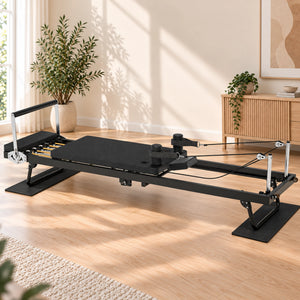
Flex F22 Foldable Pilates Reformer
A foldable steel-frame reformer designed for home training, with a smooth carriage system, adjustable setup, and dual resistance system.
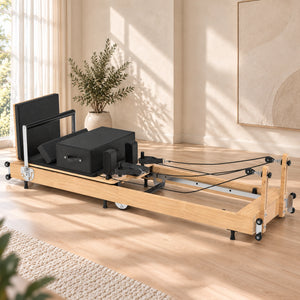
Explore Flex F22 →Gaia X1 Wooden Pilates Reformer
A foldable wooden reformer combining a refined home-focused appearance with smooth carriage movement and adjustable spring resistance.
Explore Gaia X1 →Foldable or Traditional: Which Fits Your Home?
The difference between a foldable and traditional Pilates reformer ultimately comes down to how you plan to use your space.
If you have a permanent Pilates room and want your equipment ready at all times, a traditional fixed reformer can be a practical choice.
If your home needs to stay flexible, a foldable reformer provides another option — allowing you to enjoy reformer Pilates while making it easier to manage your living space between sessions.
The most useful reformer is ultimately the one that fits both your training needs and your everyday environment.
Bring Pilates Into Your Home
Explore Pilena reformers designed for smooth movement, adjustable training, and space-conscious home use.
Explore Pilena Reformers
