
Pilates Reformer Resistance Explained: Springs, Cords & Resistance Levels
Resistance is one of the defining features of Reformer Pilates — and one of the most confusing parts for beginners.
Some reformers use traditional steel springs, others use elastic cords, and some combine both systems. You may also see resistance described by color, pounds, kilograms, or simply as light, medium, and heavy.
Understanding how resistance works can help you make better sense of your reformer and choose settings that fit the exercise you are performing.
What Does Resistance Do on a Pilates Reformer?
The carriage of a Pilates reformer moves along a rail system. Springs, cords, or other resistance components connect the carriage to the frame and create tension as the carriage moves.
Changing the resistance changes how the reformer responds during an exercise. Depending on the movement, resistance can provide challenge, assistance, stability, or feedback.
This is why resistance on a reformer is more nuanced than simply choosing a heavier or lighter weight.
More resistance does not always mean a more difficult exercise. The effect of resistance depends on the movement, your position, and whether the springs or cords are assisting or resisting that movement.
What Is the Difference Between Springs and Cords?
Controlled, Mechanical Resistance
Steel springs are widely used on Pilates reformers. Different spring strengths can be combined to create a range of resistance settings for different exercises.
Smooth, Progressive Tension
Elastic resistance cords stretch as the carriage moves, creating smooth tension that increases through the length of the movement.
Neither system is automatically better. The training experience depends on the complete reformer design and how the resistance system is intended to be used.
Springs vs. Cords: At a Glance
Why Heavier Resistance Is Not Always Harder
One of the most common beginner assumptions is that more springs automatically make every exercise harder.
On a reformer, that is not always the case.
In some exercises, heavier resistance requires more force to move the carriage. In others, added resistance can provide more support or stability, which may actually make the movement easier to control.
With lighter resistance, the carriage may feel less supported and require more control from your body.
Think of resistance as a way to change the character of an exercise, not simply as a difficulty dial that goes from easy to hard.
Resistance Can Affect More Than Strength
How Much You Push or Pull
Some exercises require more muscular effort as resistance increases.
How the Carriage Responds
Lighter settings can sometimes require greater control because the carriage has less resistance stabilizing its movement.
How Much Assistance You Feel
Depending on the exercise, resistance may help support part of your movement rather than simply oppose it.
How Smoothly You Move
The right resistance should allow you to move through the exercise with control rather than forcing or rushing the carriage.
Why Do Reformers Have Multiple Springs or Cords?
Multiple resistance components give you more flexibility than a single fixed resistance level.
By using one spring, several springs, or different combinations of spring strengths, you can create different resistance settings without changing the entire machine.
The same idea applies to reformers that use elastic cords. Adding or removing cords changes the overall resistance available during training.
A reformer with several resistance options can therefore support a wider variety of movement patterns and training preferences.
What Do Different Spring Colors Mean?
Some reformers use different spring colors to make resistance levels easier to identify.
It is important to remember that spring colors are not universal across every manufacturer. A red spring on one reformer may not provide the same resistance as a red spring on another.
Always check the specifications for the specific reformer you are using rather than assuming the resistance based only on color.
Spring color is a visual reference, not a universal resistance standard. Use the manufacturer's stated resistance levels for your specific machine.
How a Multi-Spring System Can Work
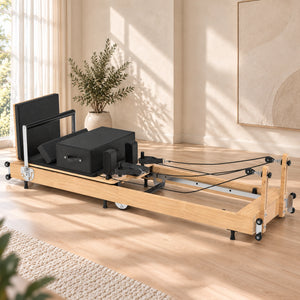
The Gaia X1 uses five steel springs with three different resistance levels. This gives users the ability to combine different springs depending on the exercise and desired resistance.
5 Steel Springs
Rather than treating one spring color as the “correct” setting, the different resistance levels allow the reformer to be adjusted for different movements.
What Is a Dual Resistance System?
Some reformers combine two resistance types instead of relying on springs alone.
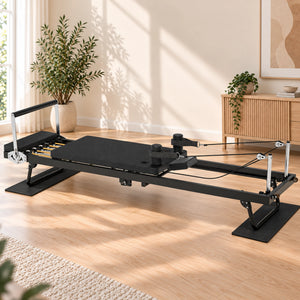
The Flex F22 uses both steel springs and latex resistance cords, giving the machine two different sources of resistance that can be combined in multiple ways.
5 Latex Cords + 4 Steel Springs
The advantage of this type of system is flexibility. You are not limited to only one resistance type when adjusting the reformer for different exercises.
How Should Beginners Think About Resistance?
If you are new to Reformer Pilates, resistance can feel confusing because there is no single setting that works for every exercise.
Start With the Exercise
Choose resistance based on the movement you are performing rather than automatically choosing the lightest or heaviest setting.
Prioritize Control
A useful setting should allow you to move the carriage smoothly without losing control of the movement.
Change One Thing at a Time
When learning how different settings feel, small adjustments can make it easier to understand how resistance changes the exercise.
Do Not Chase Maximum Resistance
Reformer Pilates is not about using the highest resistance possible. More resistance is simply another training variable.
When Might You Change the Resistance?
Resistance may need to change when you move from one exercise to another, even within the same workout.
You may adjust resistance when:
- The exercise changes.
- Your body position changes.
- You need more or less carriage support.
- You are focusing on a different movement quality.
- The current setting prevents smooth, controlled movement.
The goal is not to find one resistance setting and leave it there forever. Adjustability is part of what makes the reformer versatile.
3 Resistance Mistakes Beginners Often Make
Assuming Heavier Is Always Better
More resistance may be useful for some movements, but it can change the purpose or mechanics of another exercise entirely.
Assuming Lighter Is Always Easier
Less resistance can sometimes reduce support and require more stability and control from your body.
Copying Another Person's Setting Without Context
Resistance depends on the exercise, reformer model, spring or cord specifications, and individual training needs. A setting used on one machine may not translate directly to another.
What Should You Look for in a Resistance System?
When comparing reformers for home use, do not look only at the maximum resistance number.
Consider:
- How many resistance components are included
- Whether different resistance levels are available
- How easily springs or cords can be changed
- How many useful combinations the system provides
- Whether the resistance system suits the type of training you want to do
A useful resistance system is not necessarily the one with the biggest number. It is the one that gives you practical, adjustable options for different movements.
Two Different Approaches to Adjustable Resistance
Pilena's Flex F22 and Gaia X1 use different resistance designs, giving home users two different approaches to adjusting their Pilates training.
Flex F22 Foldable Pilates Reformer
Combines 5 latex resistance cords with 4 steel springs for a total resistance of 155 lbs and flexible resistance combinations.
Explore Flex F22 →Gaia X1 Wooden Pilates Reformer
Uses 5 steel springs across three resistance levels, providing 125 lbs of total resistance and multiple spring combinations.
Explore Gaia X1 →Resistance Is About Control, Not Just Strength
Springs and cords are central to the Reformer Pilates experience, but their purpose goes far beyond simply making an exercise harder.
Resistance can change how much force you use, how supported the carriage feels, how much control a movement requires, and how an exercise responds throughout its range.
Learning to understand those differences is part of becoming more comfortable with the reformer.
Instead of asking, “What is the hardest setting?” a more useful question is: “Which resistance setting supports the movement I am trying to perform?”
Explore Adjustable Home Pilates Training
Discover Pilena reformers with flexible resistance systems designed for controlled, adaptable home Pilates workouts.
Explore Pilena Reformers
