
How to Choose a Pilates Reformer for Home Use
Choosing a Pilates reformer for home can feel surprisingly complicated. Two machines may look similar at first glance, yet differ significantly in size, resistance, frame construction, adjustability, storage, and everyday usability.
The best reformer is not simply the one with the longest feature list. It is the one that works with your space, your training preferences, and the way you actually plan to use it at home.
This guide walks through the most important things to consider before choosing a home Pilates reformer.
1. Measure Your Home Before Comparing Reformers
Before comparing springs, cushions, accessories, or frame materials, start with the simplest question: where will the reformer go?
A reformer needs enough room not only for the machine itself, but also for you to move comfortably around it during exercises.
Measure the area where you plan to train and consider whether the reformer will remain there permanently or need to be stored between sessions.
Always compare both unfolded dimensions and storage dimensions. A reformer may fit your room while in use but still be difficult to store afterward.
7 Things to Consider When Choosing a Home Reformer
Overall Dimensions
Check the full length and width of the reformer and make sure there is additional room for movement around the machine.
Construction & Stability
Frame material, structure, and overall build all influence how substantial the reformer feels during training.
Smooth Movement
Look for a well-designed rail and roller system that allows the carriage to move smoothly and consistently.
Training Range
Multiple resistance levels and combinations can give you more flexibility across different exercises and training intensities.
Fit Your Movement
Footbar positions, rope settings, and other adjustments can help the reformer adapt to different exercises and users.
Support & Cushioning
Carriage cushioning, shoulder supports, head support, and strap comfort all affect the everyday training experience.
How It Fits Your Home
If your workout room serves multiple purposes, consider whether the reformer can be folded, moved, or stored more easily.
Steel or Wood: Which Frame Is Right for Your Home?
Frame material is partly about construction and partly about how you want the reformer to look within your home.
Clean & Functional
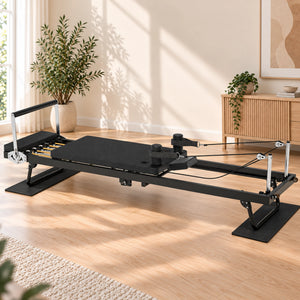
Steel-frame reformers can suit a modern, streamlined home training setup and are often chosen by users who prioritize practical function and a more equipment-focused appearance.
Warm & Home-Focused
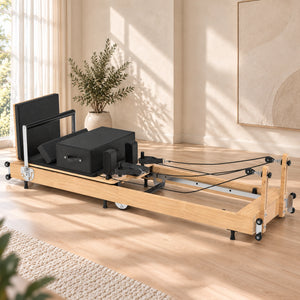
Wooden reformers can bring a warmer, furniture-inspired appearance into the room, making them particularly appealing when the reformer remains visible within the living space.
Neither material is automatically the right choice for everyone. Consider both the construction of the individual reformer and how you want the equipment to fit visually into your home.
Pay Attention to the Carriage and Rail System
The carriage is one of the parts of a reformer you interact with most frequently. Smooth, controlled movement can make transitions feel more natural throughout a session.
When comparing reformers, look at how the carriage travels along the rails and how the roller system is designed.
A home reformer should feel controlled and consistent rather than distracting you with unnecessary noise or uneven movement.
Understand the Resistance System
Resistance is one of the defining features of reformer Pilates. Different machines may use springs, elastic cords, or a combination of resistance systems.
Rather than focusing only on the total resistance number, look at how many individual resistance levels are available and how they can be combined.
More combinations can make it easier to adjust the reformer for different movements and training goals.
When comparing resistance systems, consider adjustability and usable combinations, not simply the highest resistance number.
Look for Adjustments That Support Different Exercises
A reformer is designed to support many different movement patterns, so adjustability can be an important part of the experience.
Depending on the model, useful adjustments may include:
- Multiple footbar positions
- Adjustable rope lengths or rope positions
- Shoulder support positioning
- Different resistance combinations
- Compatible accessories for additional exercise options
You do not necessarily need the machine with the most adjustments. Focus on adjustments that are practical for the exercises you expect to perform.
Comfort Matters More Than It May Seem
A reformer is a piece of training equipment, but many exercises involve sustained contact with the carriage, shoulder supports, straps, and head support.
Cushioning should feel supportive without feeling excessively soft, while shoulder supports and straps should help you maintain a comfortable training position.
Small comfort details can make a noticeable difference when you use the reformer regularly.
Decide Whether You Need a Foldable Reformer
If you have a dedicated Pilates room, you may be perfectly happy leaving your reformer fully assembled at all times.
If your Pilates space is also a living room, office, bedroom, or shared room, storage becomes much more important.
A foldable design can help reduce the amount of permanent floor space dedicated to the machine, while transport wheels can make repositioning easier.
Before purchasing, check the actual folded dimensions rather than relying only on the word “foldable.”
Do Not Forget Assembly, Accessories, and Warranty
The buying decision does not end with the machine itself. Consider what ownership will look like after the reformer arrives.
Ask Yourself These 6 Questions
- Where will I use the reformer?
- Will it stay set up or need to be stored after training?
- Which resistance options do I actually need?
- Which adjustments will matter for my workouts?
- Do I prefer a steel or wooden frame in my home?
- What is included with the reformer I am considering?
If you can answer these questions clearly, comparing different reformers becomes much easier.
Two Different Approaches to Home Pilates
Pilena offers different reformer designs so you can choose the setup that better fits your space, training preferences, and home style.
Flex F22 Foldable Pilates Reformer
A foldable steel-frame reformer designed for home use with smooth carriage movement, adjustable training features, and a dual resistance system.
Explore Flex F22 →Gaia X1 Wooden Pilates Reformer
A foldable wooden reformer combining smooth movement and adjustable spring resistance with a warmer, furniture-inspired home design.
Explore Gaia X1 →Choose the Reformer That Fits Your Life
There is no single reformer configuration that is right for every home.
A good buying decision starts with understanding your available space, how you want to train, and how the machine will fit into your everyday routine.
From frame construction and resistance to comfort and storage, focus on the features that will actually affect how you use the reformer — not simply the number of features listed on the product page.
The right home reformer should support both your Pilates practice and the way you live.
More Home Pilates Guides
Find the Right Reformer for Your Home
Explore Pilena reformers designed around smooth movement, adjustable training, and modern home living.
Explore Pilena Reformers
